You Don't Need a Data Team to Get AI Working
Most AI readiness advice says build a data team and document everything first. For a mid-sized company that is months of work before a single outcome.
By Craig Tracey ·

There's a piece of advice making the rounds, and it's quietly killing AI projects at mid-sized companies.
It goes like this. Before you can get value from AI, you need to get ready. Stand up a data team. Document all your APIs. Codify your tribal knowledge into a wiki. Run a six-week discovery to map your processes. Build the warehouse first. Then, maybe, you can start.
It sounds responsible. It's a stall.
For a company with a 200-person platform org, that prep work is annoying but doable. For everyone else it's a wall. If you run a 40-person company, or a marketing team, or a support org, you don't have a data team to spare. You have a business to run and a number to hit. The readiness checklist isn't a roadmap. It's the reason you never start.
Here's the part nobody selling you the readiness project wants to say out loud: you don't need most of it.
The readiness trap
Every readiness checklist rests on one assumption. That the context your AI needs has to be built by hand before AI can use it.
Curate the knowledge base. Write the documentation. Define the metrics. Map the processes. Get a human to sit down and describe how the company works, in a format a machine can read.
This is the same assumption that made data warehouse projects take eighteen months. Someone has to model the data. Someone has to maintain the model. The moment the business changes, the model is wrong, and someone has to fix it. The work never ends, because the company never stops moving.
So the advice to "get ready" isn't wrong about what AI needs. AI does need context. It's wrong about where that context comes from and who has to build it.
Your context already exists
The readiness pitch skips over something. The context already exists. All of it.
Who owns this account. What this customer has been complaining about. Which deals are stuck. What shipped last week. Who to ask. It's all there, sitting in the systems you already run. The CRM. The helpdesk. The billing system. Slack. The project tracker.
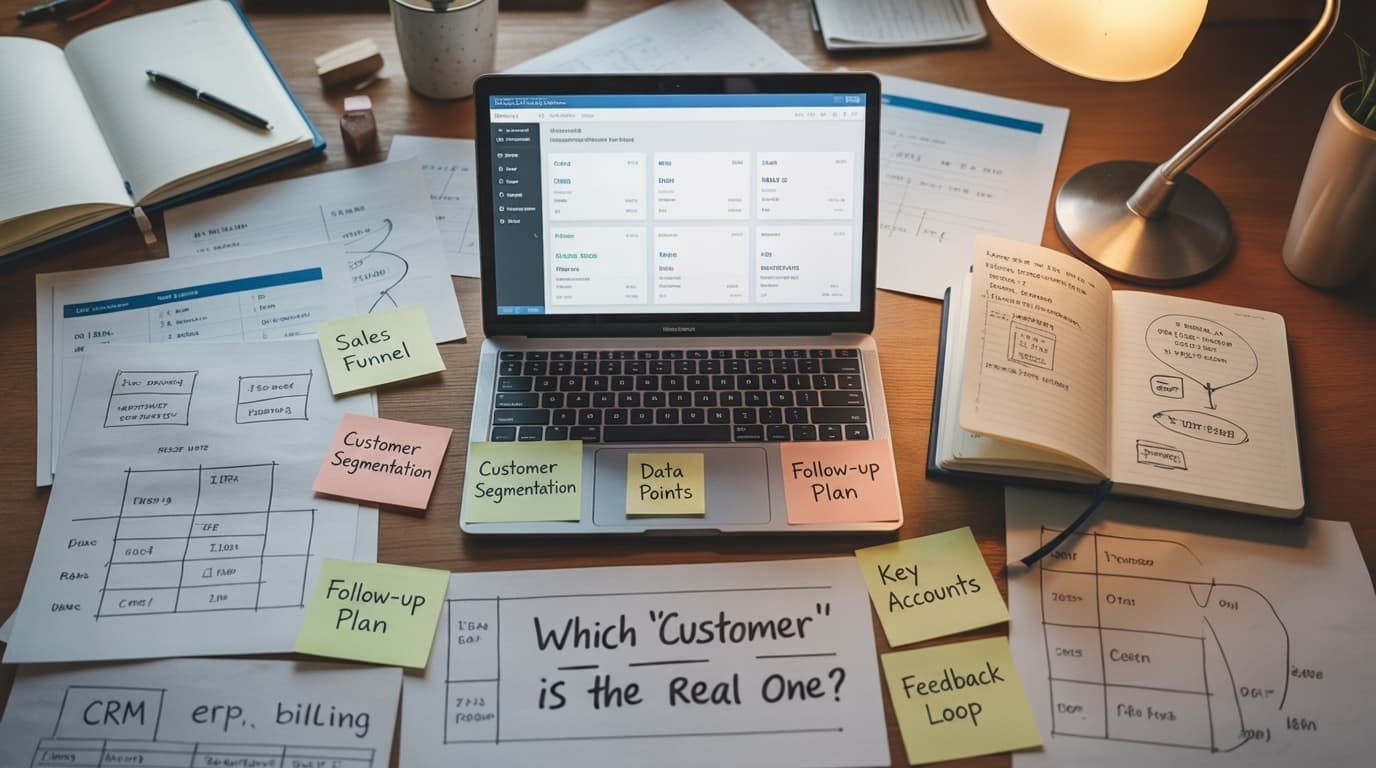
The problem was never that the context didn't exist. The problem is that it's scattered across a dozen systems, and the same customer looks like three different records depending on which tool you open. Nobody had stitched it together.
The old answer to that was simple and expensive: pay people to stitch it by hand. That's the data team. That's the modeling project. That's the readiness phase.
The stitching is the part that changed
The reason the readiness playbook is outdated is that the stitching no longer has to be manual.
A live operational graph can be derived continuously from the systems you already run. Connect Salesforce, Zendesk, HubSpot, your billing, your project tracker, and the relationships assemble themselves. The same customer in five systems resolves to one customer. Ownership, contracts, open issues, and active work all connect into one account view for RevOps, automatically, and stay current as the underlying systems change.
No one writes it down. No one maintains a model. There's nothing to keep up to date by hand, because the graph reads from the source, and the source is already being updated by the people doing the work.
That's the difference between a project and a connection. A project has a kickoff, a timeline, a team, and a maintenance burden. A connection you turn on.
What this looks like without a data team
So drop the readiness phase. Connect your systems. Here's what your team can ask on day one, in plain language, and get a real answer to.
"Which customers haven't heard from us in a month?" Eight accounts. Three are in active renewal. The biggest one at risk is worth $480k, and nobody has anything scheduled.
"Why is this support thread blowing up?" Premium account, $1.2M a year. Your AE flagged renewal risk last week. Engineering shipped a fix yesterday. Maria owns the relationship.
"What's exposed if we slip the launch?" Four deals, $3.2M, tied to six pieces of work, one of which is stuck.
None of those answers came from a person who spent a week pulling reports. They came from a graph that already knew, because it reads from the systems where the work happens.
That's AI working for the business. Not a chatbot that sounds confident and gets the details wrong. An agent that knows your live operational picture and acts on it.
The one thing that actually matters
There's one catch, and it's the thing to get right.
The graph has to be live. A one-time export, a snapshot, an integration you set up once and forget, all of it goes stale within days. The moment your context is a static copy, you're back to maintaining it by hand, and you've quietly rebuilt the data team you were trying to avoid.
Live means the picture reflects what's true right now, continuously, with nobody tending it. That's the whole game. A stale graph is just a slower way to guess.
Where a person still helps
None of this means you do it alone. There's real work in pointing AI at the right problems, wiring it into how your team actually operates, and getting the first outcomes to land. That's what a good forward-deployed engineer does.
The difference is where they start. Drop someone into a company with no connected context, and the first month is plumbing. Stitching systems, reconciling records, building the picture before anyone can act on it. By the time the picture exists, the engagement is half over.
Drop the same person onto a live operational graph and week one is outcomes. The context is already there. The work is judgment, not janitorial: which problems matter, what good looks like, how to put it in front of the people who need it. That's the engagement worth paying for, and it's the one a self-assembling graph makes possible.
You don't get ready for AI. You connect it.
The readiness project is not the path to AI working. It's the thing standing between you and the outcome.
You already have the context. It's in your systems. You don't need a team to write it down, and you couldn't afford to maintain it by hand even if you did. What you need is for it to assemble itself, stay current, and be there when an agent asks.
Stop getting ready. Connect what you already have.
See SixDegree on your stack.
Tell us where to reach you and we will set up a walkthrough against your own systems.
Keep reading

Context Engineering vs Context Management: What's the Difference?
Context engineering operates at the prompt layer. Context management is the infrastructure underneath. Mixing them up is why agent pilots fail.

Your operations run on tribal knowledge. AI will make that worse.
Every operations leader has tried to fix the opacity problem. AI agents make the cost of failure visible and immediate. Here is what changes now.
Levie Nailed the Job Description. He Left Out the Hard Part.
Aaron Levie nailed the job description. But the person he wants to hire will spend most of their time doing plumbing nobody planned for.