Context layer vs data catalog: what every AI initiative needs to know
Data catalogs document assets. AI context layers connect live entities, relationships, and evidence. Compare their purpose, limits, and when to use each.
By Craig Tracey ·
Every enterprise AI initiative hits the same wall around month four. The model is fine. The prompts are fine. The retrieval is fine. The agent still gives wrong answers about the company.
The diagnosis usually arrives in one of two forms. Either "we need better data" (which leads to a data catalog project) or "we need better context" (which leads to a context layer project). They sound similar. They are not the same thing. Picking the wrong one costs eighteen months and a budget cycle.
This post is for the person who has to make that call.
The short version
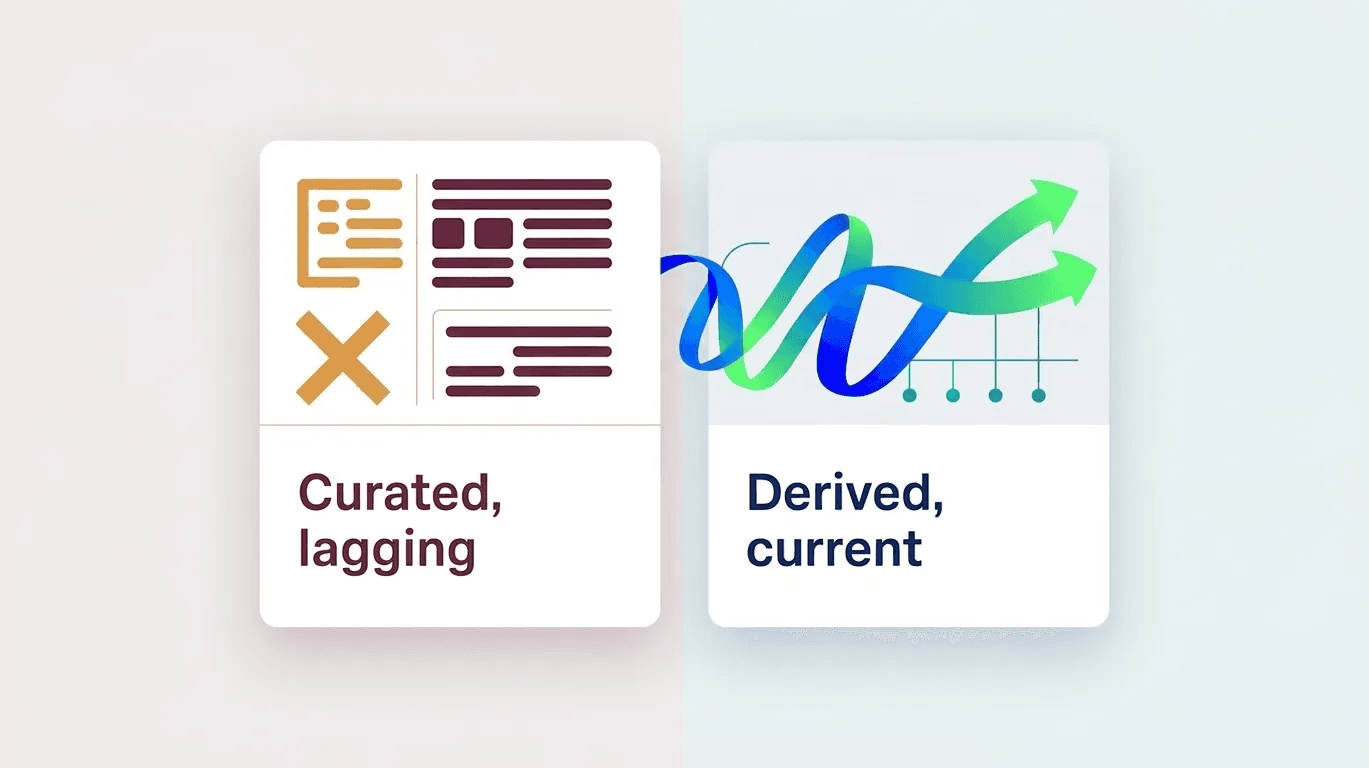
A data catalog is a curated index of data assets. Humans define what entities exist, what relationships matter, what definitions apply. The catalog stays accurate to the extent humans keep maintaining it. When the business changes faster than the maintenance cycle, the catalog drifts. By month nine, the catalog is wrong about half the things that matter, and your AI agents are reading from the wrong half as often as the right half.
A context layer is a derived graph of what your business actually is right now. Software reads from your systems of record (Salesforce, Jira, GitHub, Zendesk, Workday, the rest) and builds the picture continuously. No humans curate. No definitions get written down. Entities and relationships are observed, not declared. When the business changes, the graph reflects the change as soon as the change shows up in a system of record.
Both have a place. Catalogs are still useful for governance, lineage, and policy. Context layers are what AI agents actually need to read from to give correct answers about your company.
If you are choosing between the two for an AI initiative, you almost certainly want the context layer. The rest of this post explains why, and what to look for when evaluating either.
Where data catalogs come from
The data catalog category emerged in the 2010s to solve a real problem. As companies adopted Snowflake, BigQuery, and Databricks, they accumulated tens of thousands of tables across hundreds of pipelines. No one knew what was in any of them. Analysts spent half their time trying to find the right table and the other half trying to figure out whether they could trust it.
The data catalog answered "what tables exist, what's in them, who owns them, where did the data come from." Atlan, Collibra, Alation, data.world, Informatica all built variations on this answer. Their core mechanic was the same: a system of record for metadata, populated by a combination of automated scanning and human curation. Schemas come from scanning. Definitions come from humans. Lineage comes from a mix.
The category worked for the data analyst use case. Analysts have specific questions, time to look things up, and patience to ask a steward about ambiguous fields. The latency between "this column changed meaning" and "the catalog reflects it" could be days or weeks without breaking the workflow.
Then AI agents arrived, and the latency assumption broke.
Why catalogs struggle with AI
An AI agent answering a question does not have time to ask a data steward. It does not have patience for ambiguous fields. It cannot wait for a curation cycle. It reads what's in its context, generates a response, and the response is either right or wrong.
If the agent reads from a stale catalog, the agent is confidently wrong. The CX agent tells the customer their renewal is in 90 days when it's actually in 30. The RevOps agent forecasts a deal as committed when the champion left two weeks ago. The engineering agent points the on-call to the wrong service because ownership shifted three sprints ago.
These are not retrieval failures. The retrieval is working perfectly. The catalog being retrieved from is wrong.
The standard response is "we need better governance, more stewards, faster curation cycles." That works in theory. In practice, the headcount required to keep a manually-curated catalog accurate at AI speed exceeds what most enterprises will fund. And even fully-funded curation cycles produce stale data within weeks of completion, because business reality moves faster than human update cycles.
The deeper problem is structural. A catalog is a static representation of a moving target. The moment a human writes down "this account is owned by this AE," that statement starts decaying. The AE leaves. The account is reassigned. The relationship is renamed. The deal is split. None of those changes propagate back to the catalog automatically. They require either a curator updating the catalog or a system pushing changes to the catalog, both of which add latency, fragility, and cost.
For analyst workflows, the latency is acceptable. For AI workflows, it isn't.
What a context layer is
A context layer is a different category, even though the surface use case ("AI agents that know your company") sounds adjacent. The structural choice is the opposite.
Instead of declaring entities and relationships, a context layer derives them. Software reads from your systems of record continuously. A rules-based ontology engine identifies what counts as an entity (an account, a deal, a service, a deployment, a person) and what counts as a relationship (this account belongs to this AE, this deploy touched this service, this engineer owns this codebase). The graph emerges from the structure of your real systems, not from a separate maintenance effort.
When a record changes in Salesforce, the graph updates. When a deploy lands in production, the graph reflects it. When an engineer leaves and ownership shifts, the graph follows. There is no curation cycle because there is nothing to curate. There is no maintenance backlog because the maintenance is the data flow itself.
The technical foundations differ from a catalog. Catalogs are typically built on relational schemas with metadata tables. Context layers are built on graph databases (Apache AGE, Neo4j, custom graph stores) because the structural truth being represented is fundamentally relational, not tabular. The query language is graph traversal (Cypher, Gremlin) rather than SQL. The exposure surface is increasingly MCP rather than REST or JDBC, because AI agents are the primary consumers.
The result is a substrate that AI agents can read from with confidence. The graph is current because it derives from current systems. The semantics are real because they came from observed behavior, not from someone's documented intentions.
The four points of structural difference
Compare the two on the dimensions that matter for AI workloads.
Source of truth. Catalogs treat the catalog itself as a source of truth that mirrors underlying systems. Context layers treat the underlying systems as the only source of truth and the layer as a derived view. When the two diverge, catalogs require reconciliation. Context layers regenerate.
Maintenance model. Catalogs require ongoing human investment to stay accurate. Steward roles, governance committees, periodic reviews, and update cycles. Context layers require integration coverage. Once a system of record is connected, the layer maintains itself relative to that system.
Latency to truth. Catalogs lag reality by whatever the curation cycle is. Most enterprise catalogs operate on weekly to monthly cycles for definitional changes. Context layers lag reality by whatever the integration sync interval is. Most context layers operate on minute-scale refreshes for structural changes.
Failure mode. Catalogs fail by drift. The catalog says one thing, reality says another, the catalog wasn't updated. Context layers fail by integration gap. The system of record exists but the integration to it doesn't. Both failures are recoverable, but they have different mitigation strategies. Catalog drift requires more humans. Integration gaps require more code.
The "more code" failure mode is what makes context layers tractable for AI initiatives. A code problem can be solved by engineering investment with predictable scaling. A "more humans" problem requires permanent operational investment that scales unfavorably with company complexity.
Where catalogs still have a foothold
This is not an argument that data catalogs are obsolete or that context layers replace them everywhere. The transition is real but uneven.
Catalogs have an established place in legacy governance workflows. Auditors, compliance teams, and data stewards are accustomed to catalog interfaces. Internal processes are wired to them. RFP responses cite them. Replacing a catalog wholesale in a regulated industry is a multi-year project that few CIOs are eager to start.
For organizations not yet ready to make that transition, catalogs continue to serve. Definitional consistency requires curation when "active customer" means three things in three departments. Some compliance frameworks expect curated artifacts and don't yet recognize derived ones.
But the structural argument is that context layers can serve governance, lineage, and policy use cases as well as or better than catalogs in most cases. Lineage in a context layer is observed, not declared. Access governance reflects who actually has access right now, not who was documented as having access at the last review. Definitional drift is detectable because the layer can compare declared meaning against observed behavior continuously.
The companies leading the transition are the ones treating governance as a derivation problem rather than a curation problem. The ones still treating it as curation are the ones whose catalogs and AI agents both struggle to keep up with the business.
What to look for if you're evaluating
If you're picking infrastructure for an AI initiative, three questions cut through most of the marketing.
How does the system know what an account, a deal, or a service is? If the answer involves humans defining entity types or schema mappings, you're looking at a catalog. If the answer involves rules that infer entities from observed structure, you're looking at a context layer. Neither answer is wrong, but they support different workloads.
What happens when reality changes? If a deal is reassigned to a new AE on Tuesday, when does the system reflect it? Monday-after-the-curation-cycle is one answer. Within minutes of the Salesforce sync is another. Same question, different categories.
Who is the consumer? If the consumer is a data analyst running ad-hoc queries with time to investigate, a catalog can serve them. If the consumer is an AI agent generating responses in real time, the catalog probably can't.
The third question is the one that's been changing rapidly. Three years ago most metadata consumers were humans. Today increasingly they're agents. Five years from now agents will be the dominant consumer of structural metadata in the enterprise. The infrastructure choices made now should anticipate that shift.
The deeper claim
The reason a context layer matters is not that it's better metadata management. It's that it's a different category of thing.
A catalog asks humans to describe the company. A context layer derives the company from the company's own behavior. Those produce different kinds of artifacts even when they share use cases. The catalog produces a documented version of the company that ages from the moment it's written. The context layer produces a live representation of the company that updates with the company itself.
For AI agents to give correct answers about an organization, they need to read from a representation that's true at query time. Catalogs can be true at curation time. Context layers can be true at query time. That difference is what makes context layers the right substrate for AI initiatives, and what makes catalogs the wrong place to point your agents.
The companies figuring this out first are the ones whose AI initiatives are starting to deliver real outcomes instead of stalled pilots. The ones still pointing agents at curated catalogs are still wondering why the model keeps hallucinating.
It isn't the model. It's the substrate.
Frequently Asked Questions
What is the difference between a context layer and a data catalog?
A data catalog is a curated index of data assets that humans define and maintain, so it drifts when the business changes faster than the curation cycle. A context layer is a derived graph of what your business is right now, built continuously by software reading from your systems of record. A catalog is true at curation time; a context layer is true at query time.
What is a context layer?
A context layer derives entities and relationships from your systems of record instead of having humans declare them. A rules-based ontology engine identifies what counts as an account, deal, service, or person and how they relate, and the graph updates as soon as a change shows up in a source system. There is no curation cycle because the maintenance is the data flow itself.
Can our data catalog serve as the context layer for agents?
Not reliably. A data catalog describes the data estate: where tables live, what a column means, which pipeline produced it. An agent acting on your business needs the operational state itself, which account is at risk, who owns this service, what changed this week, resolved across the systems where that state actually changes. A catalog can tell an agent where to look. It cannot tell the agent what is currently true, because the catalog is curated on a maintenance cycle and the systems move faster than the curation.
Do I still need a data catalog if I have a context layer?
Catalogs still have a foothold in governance, lineage, and compliance workflows that expect curated artifacts, and replacing one in a regulated industry is a multi-year project. But a context layer can serve most governance, lineage, and policy use cases as well or better, because lineage and access are observed rather than declared.
Which one do AI agents need to give correct answers?
For an AI initiative you almost always want the context layer. Agents read context, generate a response, and are either right or wrong with no time to ask a steward. They need a representation that is true at query time, which a derived, live context layer provides and a manually curated catalog cannot.
Give the agent the account, not another lookup step.
SixDegree connects the same account across CRM, support, product, billing, conversations, and engineering. See how that context exposes forecast risk and renewal risk before the CRM changes.
Keep reading

When Gainsight and Salesforce disagree about the same customer
Why Salesforce and Gainsight customer health data disagree, when syncing destroys useful signal, and how to keep each value tied to its source.
Contracted revenue says one thing. Billing says another.
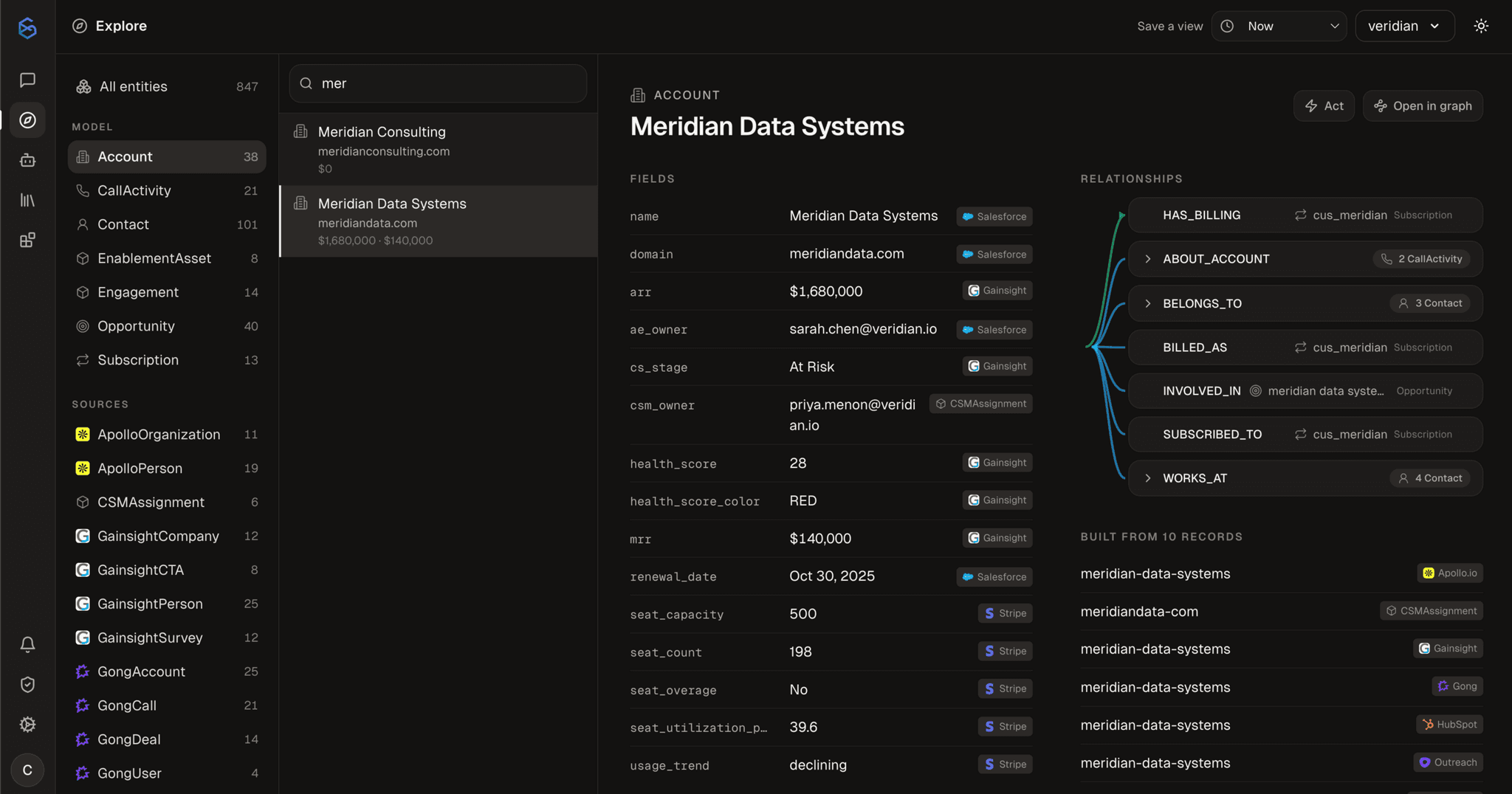
The CRM records what was sold. Stripe records what is being invoiced. When those diverge, the gap is usually a real event nobody logged.

Hallucination Is the Feature, Not the Bug
A talk on why agents need ontologies nails the diagnosis but stops short of the hard parts. This is exactly what we've been building.