Your CRM can be clean and still be incomplete.

Deduplication and required fields improve the CRM record. They do not add the support, usage, billing, relationship, and delivery evidence that lives somewhere else. SixDegree connects that context without replacing CRM.

Start read-only. Keep your existing systems. Trace every answer to its source.

Four CRM data quality problems that affect revenue.

CRM data quality is not one problem. Correctness, completeness, identity, and freshness fail differently, and each requires different evidence.

Missing context

The opportunity can be perfectly complete and still omit declining product usage, an open escalation, a billing change, or a delayed dependency. The fix is not another required CRM field; it is connecting the source that owns the observation.

Conflicting values

Salesforce may report green health while Gainsight reports red. Contracted ARR may differ from the Stripe run rate. Preserve both source claims, their observed times, and the business definition behind each before deciding which one a workflow should use.

Duplicate and fragmented identities

The same customer appears as a CRM account, billing customer, support organization, product tenant, email domain, and legal entity. Revenue analysis fails when those identifiers are joined differently in every report. Resolve the real-world account once and retain each native ID.

Stale state

A field can be accurate and still describe last quarter. Track when the source observed a value and when the business says it became true. Current-state reporting without history hides when risk first appeared and whether the team could have acted sooner.
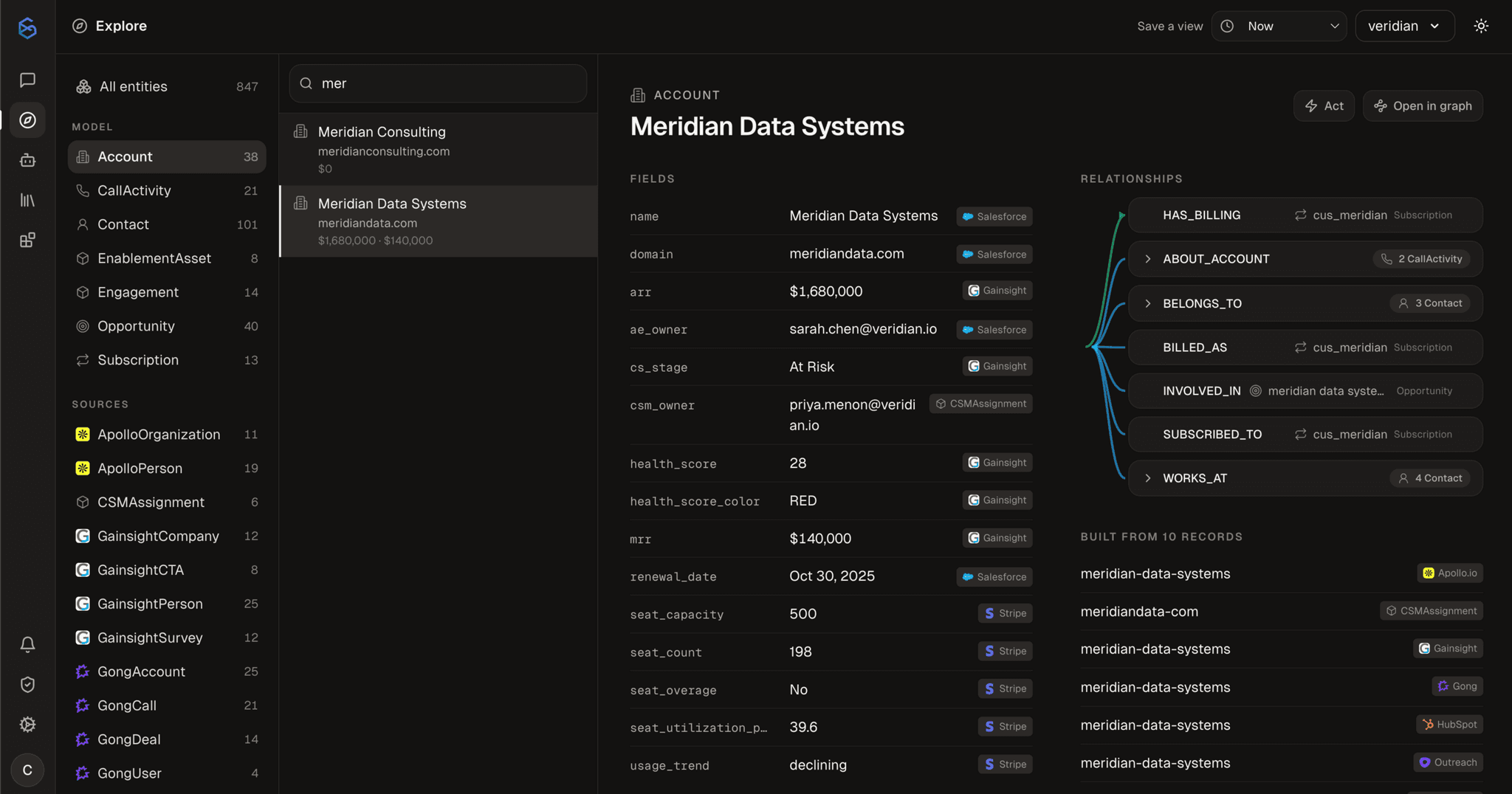
Which CRM accounts disagree with current operational evidence?

SixDegree returns the accounts, fields, outside observations, source systems, and observed times behind each disagreement so the owner can verify the commercial impact.

SixDegree entity provenance view showing account properties and the source system behind each observation
Source record
Inspect the record that supports each risk signal.
Observed time
See when the source reported it and what changed.
Revenue connection
Follow why that record affects this account, opportunity, renewal, or ARR.

The CRM is one signal, not the whole account.

Each system keeps owning what it knows. SixDegree connects the signal to the account, renewal, opportunity, ARR, and owner it can change.

Salesforce
Health is green
CRM shows no active risk
Gainsight
Health is red
Customer success disagrees
Mixpanel
Usage down 31 percent
Current adoption is missing
Stripe
Billed seats changed
Commercial value may be stale
Zendesk
P1 remains unresolved
Account impact is incomplete

From source change to revenue action.

  1. 01

    Keep native records intact

    Read the CRM and every relevant source without flattening their fields into a new master record.

  2. 02

    Resolve shared identities

    Connect the account, people, products, opportunities, renewals, tickets, invoices, and work items describing the same business.

  3. 03

    Surface material exceptions

    Prioritize stale, missing, duplicated, or conflicting evidence by the revenue decision it can change.

Questions revenue teams ask

What are the main dimensions of CRM data quality?
Common dimensions include accuracy, completeness, consistency, uniqueness, validity, and timeliness. For revenue decisions, identity resolution and source provenance are also essential because the relevant evidence spans multiple systems.
Why is CRM data incomplete?
CRM is designed to manage accounts, contacts, opportunities, and sales processes. Product behavior, support history, invoicing, customer-success activity, conversations, and engineering delivery are normally owned elsewhere.
Does SixDegree create another source of truth?
No. SixDegree keeps each source claim and connects it to shared business entities. When systems disagree, the disagreement remains visible instead of being silently overwritten.
Can this work without writing back to CRM?
Yes. A deployment can begin read-only, verify the cross-system result, and introduce scoped write actions only when the team chooses.

Bring one revenue question your CRM cannot answer.

We’ll map the systems behind it and use a read-only working session to show what becomes visible when the account and its signals are connected.

Book a working session