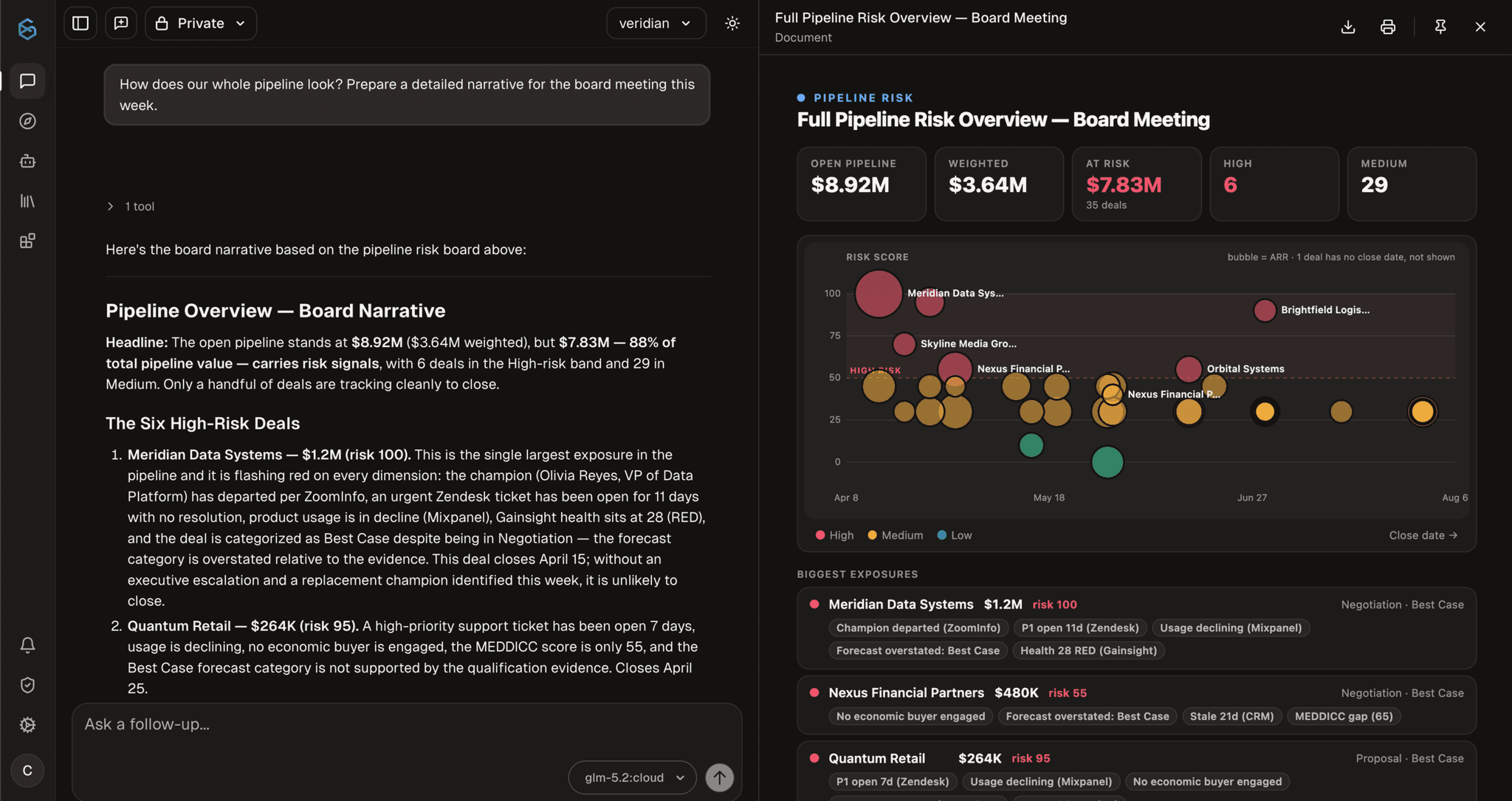
What revenue leakage actually looks like.
Revenue leakage is earned or expected revenue that a business fails to bill, collect, renew, or protect because operational reality is fragmented across systems.
Contract and billing disagree
The CRM records contracted ARR, but billing reflects a different quantity, price, start date, discount, or product package. Neither record is necessarily false. The gap is the risk.
For recurring revenue, a useful starting calculation is expected billable revenue minus actual billed revenue, divided by expected billable revenue. Keep the source and period attached to every amount.
Usage changes before the renewal does
A renewal can remain healthy in CRM while active users, consumed seats, feature adoption, or account engagement falls. That is revenue at risk rather than realized leakage, and it should be labeled separately.
Connecting usage to the contracted account and renewal date shows whether the customer is receiving the value they are expected to renew.
Delivery and support change the commercial outcome
An unresolved escalation, missed implementation milestone, or delayed capability can block an invoice, expansion, or renewal. The commercial record will often remain unchanged until someone manually updates it.
The earlier signal lives in support and engineering. The revenue consequence lives in CRM and billing. Detection requires the relationship between them.
Detection starts with disagreement, not a score
Start with one auditable question: where does contracted ARR disagree with billed revenue? Resolve the customer and product across both systems, compare the observations for the same period, and preserve each source value.
Once the result is trusted, add usage, support, renewal, and delivery signals. A score can summarize the evidence later; it should not replace it.