The escalation your renewal forecast cannot see
Support knows the account is unhappy. The forecast does not. The two systems hold the same customer under different identifiers and never compare notes.
By Craig Tracey ·
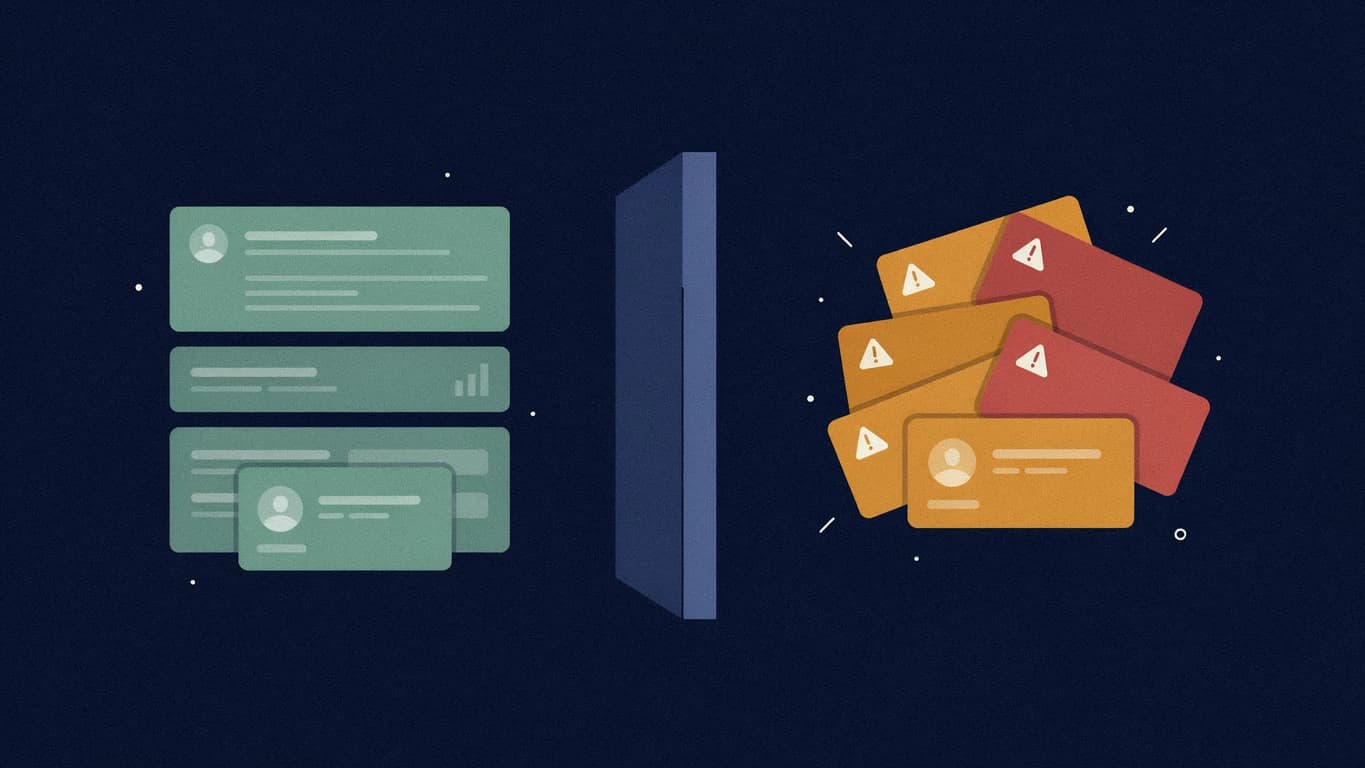
Imagine a scenario where a critical support issue opens on a Tuesday, stays open for nine days, and the customer stops replying to the thread. It's so critical that the customer's own ability to service their customers is degraded.
Meanwhile the renewal for that same account sits in the forecast at full value. After all, nothing in this sequence would change the CRM. No stage moved. No close date slipped. From the pipeline review's perspective it's still a clean quarter.
Both things are true simultaneously, in (at least) two systems, about one company. Neither system is wrong. They simply have no way to know or act on what the other one knows.
The Salesforce integration and Zendesk integration each expose the records their source owns. The missing piece is resolving those records to the same customer and renewal.
This is not a process problem, and plugins don't fix it either
After an organization is impacted by this sort of sales blind spot, the typical response is to add a process: a weekly sync where CS flags at-risk accounts, or a field in the CRM that someone updates after escalations.
Those work for a while. They fail the same way every manual intervention fails, which is that they depend on somebody noticing. The escalations that matter are more than just the ones on your top-tier accounts. They are also the moderate ticket on an otherwise quiet account whose champion has now also gone silent. And that sort of combination is exactly what nobody is actively looking for. It's a slow leak.
In some cases, you might even use a built-in connector. You install the Zendesk plugin for Salesforce, and it surfaces tickets inside Salesforce but not accounts inside Zendesk. So you install the Salesforce plugin for Zendesk. But then you need to understand product usage...
You can see where this is going.
What has to be true for the question to be answerable
"Which renewals have an open escalation?" sounds like a simple report, but it requires three things that are much harder than they look.
The support organization and the CRM account have to be recognized as the same customer. Typically they are linked by an email domain, but even domains are messy: subsidiaries, acquisitions, contractors using personal addresses, or even one company with four different domains.
Ticket severity has to mean something comparable across the systems that record it. A "P1" in your incident tracker and an "Urgent" in the helpdesk platform are not automatically the same claim. These are semantics that are sometimes encoded in a process, but more often than not, they are just understood by way of tribal knowledge.
And the state has to be current. An escalation that closed yesterday should not be flagging a renewal today, and one that opened this morning should be.
The graph version
Instead of point-to-point correlation and analysis, this problem is graph-shaped: answering it means traversing the relationships between records, not reconciling the records themselves.
Resolve the customer once across support, CRM, billing, and product, and the question stops being a report and starts becoming a traversal: from the renewal, to the account, to the tickets on that account, to their current state.
And we can run the same path the other way. A support lead looking at the nine-day P1 can walk from the ticket, to the account, to the renewal sitting behind it, and see that the thing on their queue is holding up a contract that closes in six weeks. Nobody built a second integration to make that work. It's just the same relationships, read from the opposite direction.
That matters because the two teams ask opposite questions. RevOps asks which renewals carry an escalation. Support asks which of today's tickets carry revenue. With plugins, a sync has to be built and maintained separately for each direction. A resolved graph answers both because there was only ever one set of relationships.
It also gives the severity problem somewhere to live. A "P1" and an "Urgent" become the same claim because that mapping is declared once, in the open, instead of being re-agreed in every report and otherwise left to tribal knowledge. The same is true of what counts as an escalation, or as an account. Connectedness is what makes the traversal possible; the semantics are what make the answer mean anything.
Nothing is copied into the CRM. Support keeps owning support. What changes is that the renewal and the escalation are now connected to the same entity, and either one can reach the other.
Questions this makes ordinary
- Which renewals inside 90 days have an open P1?
- Which accounts have escalated twice in a quarter and have no exec touch scheduled?
- Which closed-won deals sit on accounts with an unresolved P1?
- Which of the tickets open right now sit on an account renewing this quarter?
- Where has ticket volume risen while product usage has fallen?
The last one crosses two systems and only works once the customer is resolved across both. It also tends to turn before anything in the CRM does.
Frequently Asked Questions
How do you connect Zendesk tickets to Salesforce renewals?
Both systems hold the same customer under different identifiers, so the connection has to be made by resolving identity rather than by syncing a field. Zendesk organizes around an organization and requester domain, Salesforce around an Account. Once those are recognized as one entity, a renewal can reach the tickets on its account without either system writing into the other.
Why does support signal predict churn better than CRM fields?
CRM fields record what someone chose to enter, usually at a moment when the deal was going well. Support activity is generated by the customer as a side effect of using the product, so it updates whether or not anyone remembers to maintain it. Combined with usage and relationship signals it tends to move earlier than anything in the opportunity record.
Do we need to sync support data into the CRM?
Not for this. Syncing writes a snapshot of one system into another and has to pick which fields win. Answering the question only requires that both systems describe the same resolved customer, which leaves each one authoritative for what it actually owns.
See which renewals are exposed.
Tickets, incidents, accounts, and renewals stop being separate records of the same customer. See how SixDegree turns support activity into source-backed renewal risk.
Keep reading
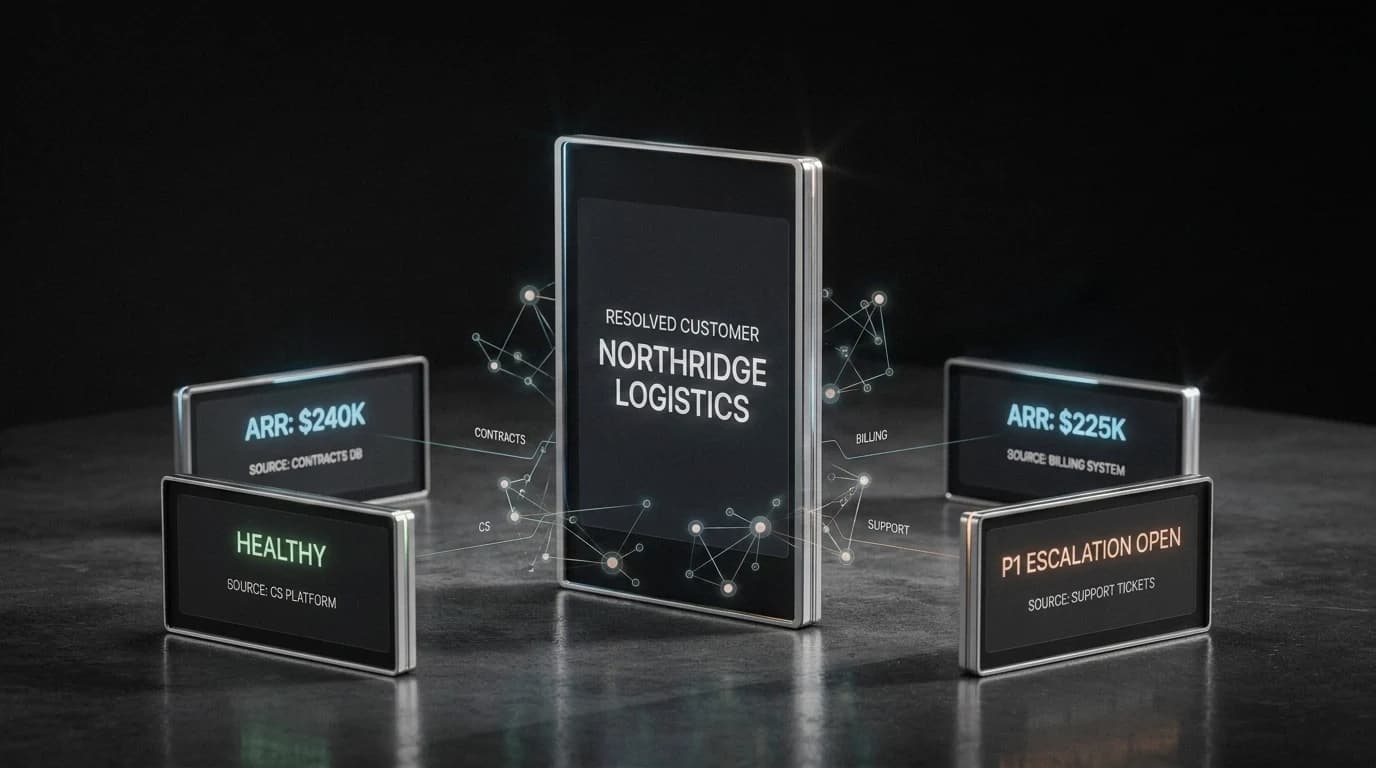
When Gainsight and Salesforce disagree about the same customer
Why Salesforce and Gainsight customer health data disagree, when syncing destroys useful signal, and how to keep each value tied to its source.
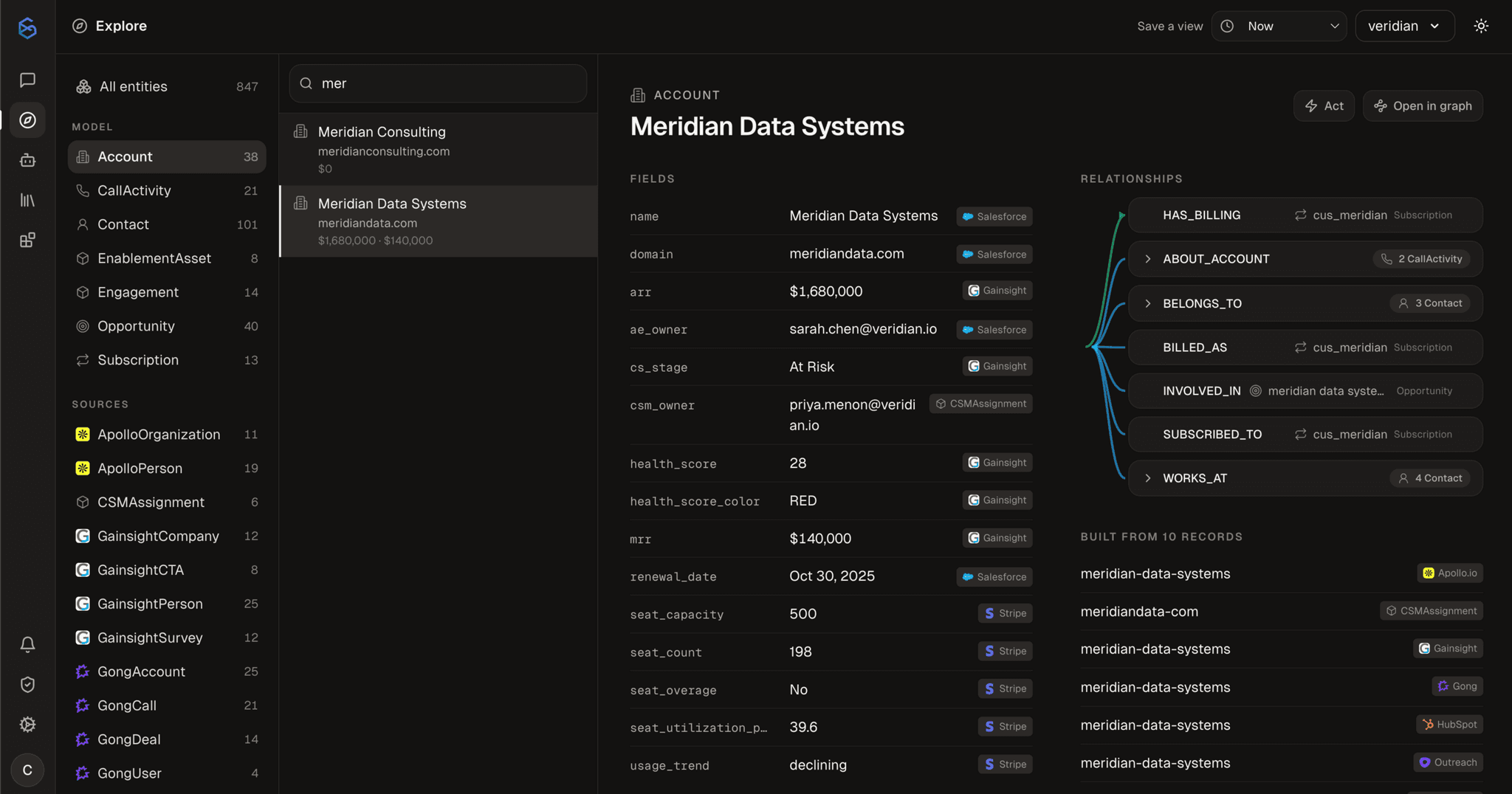
Contracted revenue says one thing. Billing says another.
The CRM records what was sold. Stripe records what is being invoiced. When those diverge, the gap is usually a real event nobody logged.
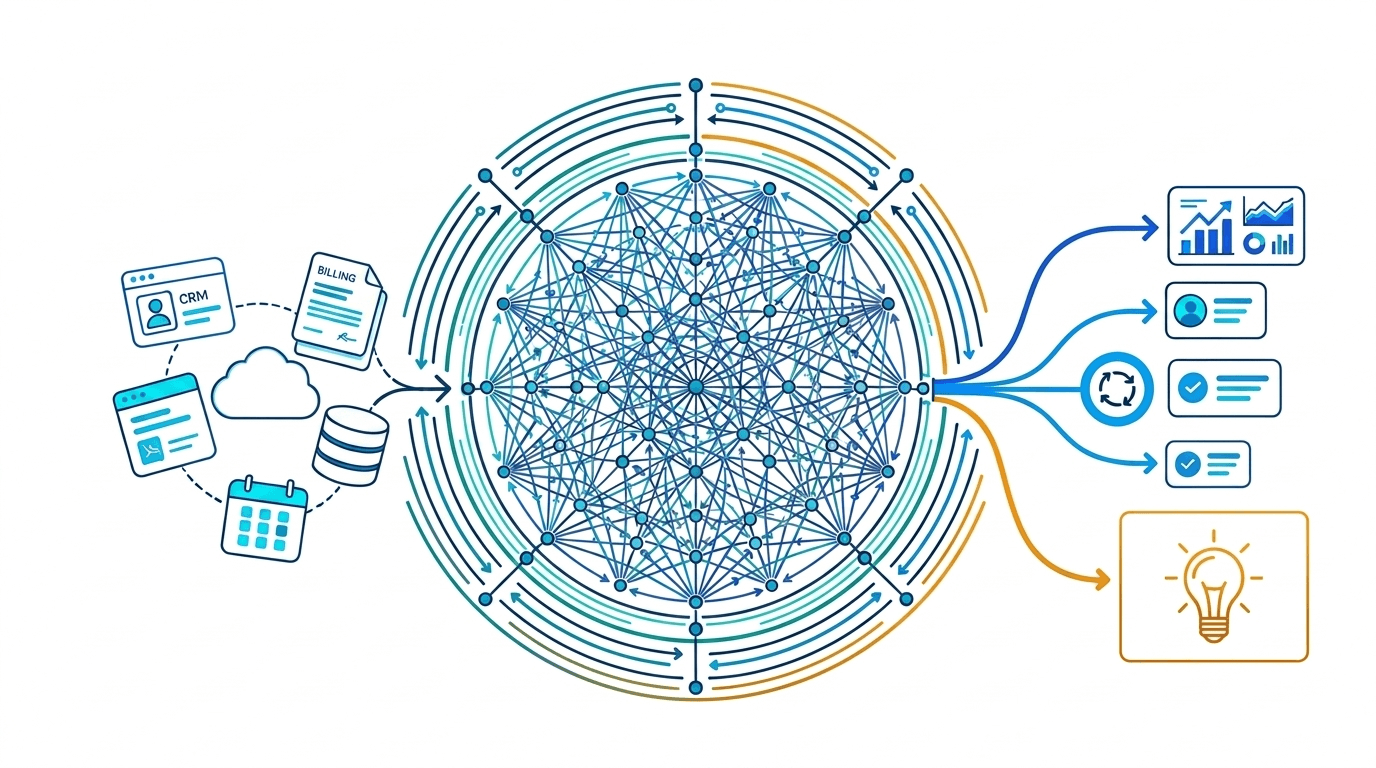
Alex Karp Is Right About Where Enterprise AI Creates Value
Palantir's CEO says the winners in enterprise AI will own the application layer and the ontology underneath it. Here's why that is right, and what it takes to keep that layer current.